

How Often Does a Commercial Property Need Fixed Wire Testing?
Five years for an office or a shop, three for industrial premises, and annually for anything higher risk. Those are the intervals most businesses work to, and they are the right starting point. What surprises people is that none of them are…
Tell us what you need and we will come back to you the same working day.
 NAPIT ApprovedMember 66463
 Competent PersonRegistered, electrical
Quick answer
Most offices and shops are tested every five years, industrial premises every three, and higher risk sites annually. None of those intervals are set by law, they come from IET guidance, and the duty on you is to keep the installation safe.
Five years for an office or a shop, three for industrial premises, and annually for anything higher risk. Those are the intervals most businesses work to, and they are the right starting point.
What surprises people is that none of them are written into law. The legal duty is broader than that, and understanding the difference is what stops you either over testing and wasting money, or under testing and ending up unable to prove anything.
The usual intervals
These are the maximum intervals commonly applied, taken from IET guidance rather than statute. A risk assessment can shorten any of them.
| Premises | Usual maximum interval | Routine checks |
|---|---|---|
| Offices and shops | 5 years | Annual visual |
| Commercial units and warehouses | 5 years | Annual visual |
| Industrial premises | 3 years | Annual visual |
| Pubs, restaurants and takeaways | 5 years | Annual visual |
| Leisure, pools and anywhere wet | 1 year | Ongoing |
| Petrol filling stations | 1 year | Ongoing |
| Caravan parks and holiday lets | 1 to 3 years | Annual |
| Construction sites | 3 months | Ongoing |
| Change of occupancy, any premises | Test before the new tenant moves in | Not applicable |
That last row is the one most often missed. A change of tenant is a trigger regardless of when the last report was done.
There is no law that says five years. What the law says is that the installation has to be maintained so that danger is prevented, and the intervals are how the industry turns that into a diary date.
Where the five year figure actually comes from
The Electricity at Work Regulations 1989 are the legal backbone. They put a duty on the employer or whoever controls the premises to maintain electrical systems so far as is reasonably practicable to prevent danger.
Note what that does not say. It does not name an interval, a document or a test. It says keep it safe and be able to show you have.
BS 7671 and the IET guidance then fill that gap with recommended maximum periods between inspections, which is where five years and three years come from. Follow them and you have a defensible position. Ignore them and you are left arguing that whatever you did instead was reasonable, which is a much harder conversation to have with an insurer.
Fixed wire testing and an EICR are the same thing
Worth clearing up, because the two terms get used as though they are different products.
Fixed wire testing is the work. Inspecting and testing the permanently installed electrics, so the distribution boards, the circuits, the socket outlets, the lighting, the isolators and everything wired in behind them. The Electrical Installation Condition Report is the document you get at the end of it.
Some contractors say fixed wire testing on commercial jobs and EICR on domestic ones out of habit. It is the same job and the same certificate.
What a report is not
It is not a test of your appliances. Anything that plugs in sits outside the fixed installation and falls under appliance testing instead, which runs on its own schedule.
It is not a fire alarm or emergency lighting certificate either. Those are separate standards with separate intervals, and an inspector asking for your compliance file will want all three.
Why the interval might be shorter than the table says
The table is a starting point and a competent inspector will tell you if your site needs more.
Age of the installation matters. So does the environment, because dust, damp, vibration and heat all age an installation faster than an air conditioned office does. Three phase equipment, heavy machinery and anything with a lot of start up current will push the interval down.
The report itself will usually recommend a next inspection date, and that recommendation beats any general table. If an inspector writes three years on a building the table would give five, there is a reason, and it will be in the observations.
What happens between inspections
The gap between a three year and a five year cycle is long enough for plenty to change, which is why the guidance pairs periodic testing with routine checks in between.
Routine checks are not a full test. They are a visual, looking for damaged accessories, missing covers, scorching, overloaded extension leads, blocked ventilation on boards and anything that has been added since the last report without anyone saying so. On most commercial sites that is an annual walk round, and it takes a fraction of the time a full inspection does.
The other thing worth doing between cycles is keeping a record of alterations. New circuits, extra sockets for a new layout, a machine moved across the floor. Each of those should have produced its own certificate, and having them filed makes the next inspection quicker and cheaper.
What it means if the report comes back unsatisfactory
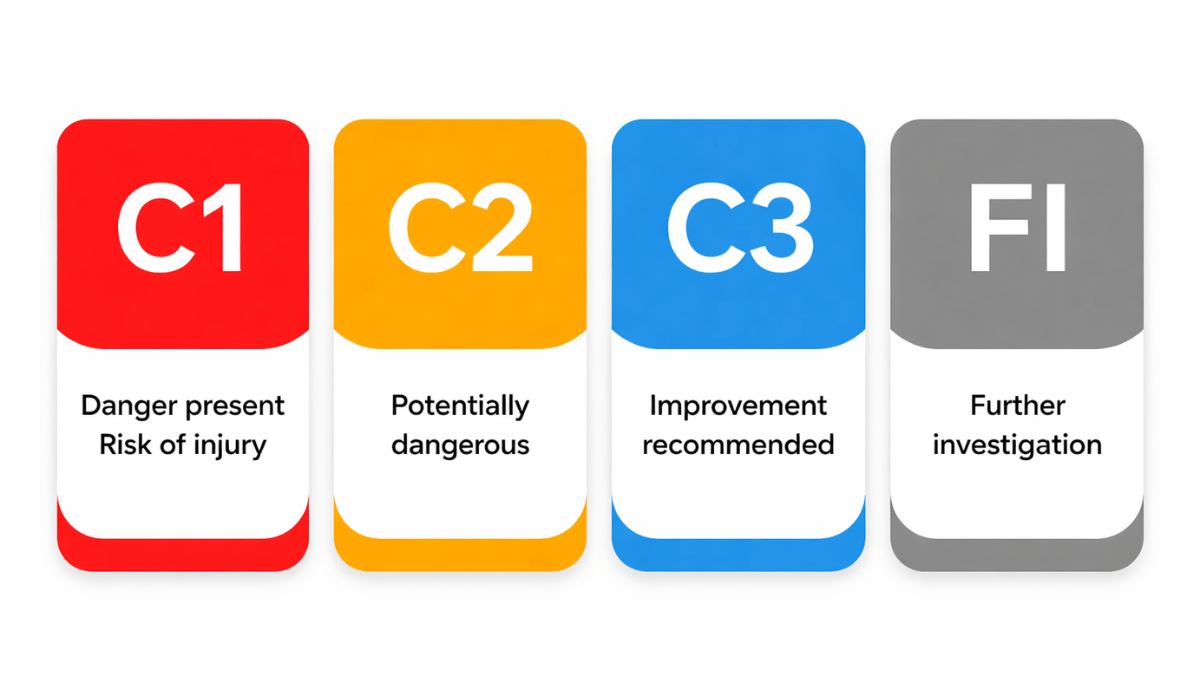
An unsatisfactory report means at least one C1 or C2 observation was found. C1 is danger present, C2 is potentially dangerous, and either one means the installation is not in a satisfactory condition until it is dealt with.
For commercial premises there is no statutory 28 day window like the one that applies to rented homes, but leaving a C1 unattended is indefensible under the Electricity at Work Regulations. Most businesses fix C1 items immediately and schedule C2 work quickly, then get the report reissued as satisfactory.
C3 items are improvement recommendations. They do not make a report unsatisfactory and they do not need actioning, although they are worth reading, because today’s C3 is often the next report’s C2.
What you should get at the end
The report itself, with the observations coded and a next inspection date on it. A schedule of circuits, so somebody can tell what is fed from where without tracing it again. A schedule of test results, which is the page of actual readings.
If any of those three are missing, the file is incomplete. Insurers and incoming tenants ask for the readings more often than people expect, and a report with no schedules behind it looks exactly like a report nobody really did.
You should also get a quotation for anything coded, itemised rather than lumped into one figure, so you can deal with the C1 and C2 items first and plan the rest.
Common questions
Is fixed wire testing a legal requirement?
Testing itself is not named in law. The duty to maintain the installation so that danger is prevented is, under the Electricity at Work Regulations 1989. Periodic inspection and testing is how that duty is normally discharged and evidenced, which is why insurers and landlords ask for the report.
Who is responsible in a leased building, the landlord or the tenant?
It depends on the lease, so read it. As a rough rule the landlord holds the common parts and the incoming supply, and the tenant holds the installation inside the demise. Where a tenant has fitted out a unit, the tenant usually owns that work and the certificates for it.
Does the whole building have to be tested at once?
No. Larger installations are often tested in portions across the cycle, which spreads the cost and the disruption. The report records what was covered, so the portions have to be tracked or you end up with gaps.
Will the power need to go off?
For parts of it, yes. Testing is done with circuits isolated, so it is normally arranged out of hours or section by section around the working day. Any contractor who says there will be no interruption at all is not planning to test properly.
How long does a commercial inspection take?
It is driven by circuit count rather than floor area. A small unit with one board might be half a day. A multi board site runs into several days, and will usually be sampled and phased rather than done in one go.
If you run a business and you are due, our commercial electrical testing Liverpool service covers the lot, from a single unit to a phased programme across a portfolio. The inspection itself is explained in more detail on our electrical inspection and testing Liverpool page, and if you would rather just talk it through, we are NAPIT approved electricians Liverpool businesses use for compliance work across Merseyside.
What this guide is based on
The standards, rules and job records behind the figures above.
- BS 7671:2018+A2:2022. The wiring regulations every inspection is coded against, so C1, C2 and C3 mean the same thing whoever carries out the test.
- The Electrical Safety Standards in the Private Rented Sector (England) Regulations 2020. The five year inspection duty and the 28 day rule for giving tenants a copy of the report.
- The Renters’ Rights Act 2025. Lifted the maximum civil penalty for breaching those standards from £30,000 to £40,000 per breach from November 2025.
- NAPIT scheme rules. What an approved contractor has to hold, record and report, including the certification we issue after every job.
- Our own job records across Liverpool and Merseyside. The figures above come from work we have actually priced and carried out, not from a national average.
Checked on 18 November 2026 by Dave Harvey, NAPIT approved contractor, member 66463. Rules change, so if you are reading this a long way after that date, give us a ring and we will tell you where it stands.
Related reading

EIC, EICR or Minor Works, Which Electrical Certificate Do You Need?
Three documents, similar names, and they get mixed up constantly. The short version is that an EIC and a Minor Works Certificate…
Landlords
How Much Does an EICR Cost? A 2026 Guide for Landlords
Ask three electricians what an EICR costs and you will get three different answers. That is not because anyone is being cagey,…
Landlords
Who Is Responsible for the EICR in a Block of Flats?
If you let a flat, there are two separate electrical installations in play and they usually belong to two different people. Miss…
The work behind it
Electrical Inspection & Testing
Full Electrical Installation Condition Reports for landlords, homeowners and businesses, with the certificate issued within 24 hours and remedials priced up front.
Fuseboard Upgrades
Swapping out old rewireable fuses and tired boards for a modern RCBO unit, tested, certified and notified under Part P within 36 hours.
Landlord Electricians
EICRs, fire alarm testing and emergency lighting for rented property across Liverpool, booked around your tenants and certified the same week.