


Emergency lighting sits quietly in the background of most buildings. You probably walk past these fittings every day without giving them a second thought. But when the power goes out and smoke fills a corridor, they become the difference between a safe evacuation and something far worse.
Testing these systems isn’t optional. UK fire safety law places a clear duty on building owners and managers to prove their emergency lighting actually works. Not just once a year, but on a regular schedule backed up by proper documentation.
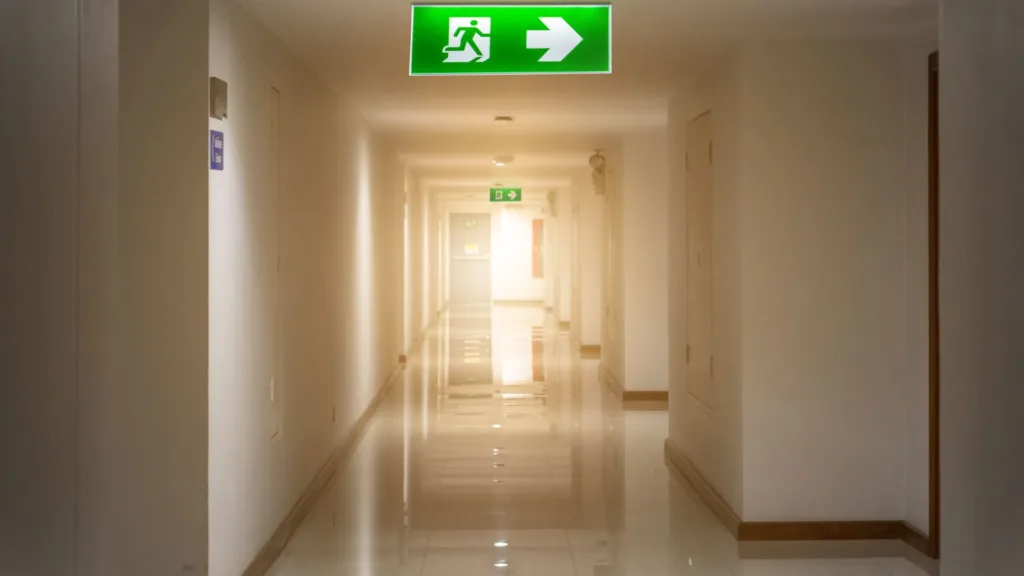
Why Emergency Lighting Must Be Tested Regularly
The Regulatory Reform (Fire Safety) Order 2005 puts legal responsibility squarely on the shoulders of the “Responsible Person” for any non-domestic building. This could be the landlord, property owner, facilities manager, or employer depending on the premises.
British Standards BS 5266-1 and BS EN 50172 spell out exactly what’s expected. These aren’t suggestions. Fire services and insurers treat them as the benchmark for compliance. Get it wrong and you’re looking at enforcement notices, potential fines, and serious questions if something goes wrong during an actual emergency.
HMOs face particularly strict requirements. Landlords must demonstrate their emergency light testing is up to date, with records available for inspection. Commercial premises carry similar obligations. The fire service can ask to see your logbook at any time.
Monthly Emergency Light Tests Explained
Monthly checks are sometimes called “functional tests” or “flick tests” in the trade. The principle is simple. You simulate a mains power failure and confirm every single fitting switches on correctly.
This doesn’t need to be complicated. The supply gets interrupted briefly, and someone walks the building checking each luminaire and exit sign. Are they all working? Are they clean and undamaged? Is anything missing or in the wrong position?
These monthly tests can often be handled in-house by a competent member of staff. You don’t necessarily need an external contractor for every check. What you absolutely must do is write it down. Date, who did the test, what failed, what action was taken. This goes in your fire safety logbook and stays there.
The test duration should be brief. Just long enough to confirm operation without draining the batteries. You still need those batteries ready if a real power cut happens later that same day.
Annual Emergency Light Tests – The Full Duration Discharge Test
Once a year, things get more serious. The annual test runs every emergency fitting for its full rated duration. For most commercial buildings, that means three hours of continuous operation on battery power alone.
This is where problems show up that monthly checks miss completely. A fitting might illuminate perfectly during a quick flick test but dim and fail after ninety minutes of actual use. Batteries degrade over time. The only way to know they’ll last through a real emergency is to run them flat and see what happens.
Planning matters here. You can’t just switch off the emergency lighting during normal business hours and hope for the best. Most building managers schedule annual tests outside working hours, often overnight or at weekends. There needs to be time afterwards for batteries to recharge and for any failed fittings to be replaced before the building fills up with people again.
This level of testing typically requires a qualified contractor. The complexity involved and the certification needed make it impractical for most in-house teams. Our electricians across Liverpool and the wider North West carry out annual discharge tests for HMOs, offices, warehouses, and retail premises throughout the region.
Recording Everything in Your Emergency Lighting Logbook
Documentation protects you. If a fire officer asks how you maintain your emergency lighting, handing over a detailed logbook answers that question instantly. Without records, you’re asking them to take your word for it. That rarely ends well.
Your logbook should show every monthly test with dates and findings. It needs to record every annual full-duration test with detailed results. Any failures must be logged alongside the remedial work carried out and confirmation that fittings passed a retest afterwards.
Some building managers use downloadable templates. Others prefer bound logbooks that can’t have pages removed. Either works as long as the information is complete and legible.
Getting Your Emergency Light Testing Right
Proper testing protects the people in your building. It keeps you on the right side of fire safety law. And it gives you documented proof that you’ve done everything expected of you.
If you manage an HMO, commercial property, or any premises requiring regular fire alarm testing and emergency lighting checks, our team can help. Call us or email [email protected] to arrange your 6-month or annual testing.